A kiss on the doorstep before leaving for work, another stolen in the middle of a conversation, a final one placed on the forehead for no apparent reason. The way a man kisses changes when his feelings deepen. It’s not a matter of technique, but of tempo, pressure, and those micro-gestures that often go unnoticed.
Dopamine, oxytocin: what happens in the brain during a romantic kiss
We underestimate how much biochemistry betrays feelings. Romantic kisses activate the same brain reward circuits as certain drugs, through an increased release of dopamine and oxytocin. This hormonal cocktail strengthens attachment and encourages prolonged contact.
In practical terms, this translates into observable behavior: a man in love slows down the pace of his kisses. He does not seek a quick spike of excitement. He seeks repetition, prolongation, a return to kissing even outside of any sexual context.
This is what distinguishes a kiss of fleeting desire from a kiss of attachment. The former speeds up, the latter stretches out. We have all experienced the difference without necessarily putting a word to it. Understanding how a man in love kisses starts with this observation of tempo.
Lip pressure and kiss rhythm: the physical signs that don’t lie
Let’s take a mundane situation: a couple sitting on a couch, the television on. The man turns and kisses his partner. This kiss, seemingly trivial, says a lot depending on how it unfolds.
Adjusted pressure rather than mechanical
A man in love adjusts the pressure of his lips to the reactions of the other. He does not press his mouth as if to check a box. He modulates, slows down if he senses tension, presses more when the exchange naturally intensifies.
This real-time adjustment ability is linked to non-verbal feedback. Recent content on relational health emphasizes the role of implicit consent in the way of kissing: a man who loves checks his partner’s comfort, sometimes verbally (“are you okay?”), often with a simple pause to gauge a reaction from the face.
The hands during the kiss
The lips tell only part of the story. What the hands are doing at the same time is equally telling.
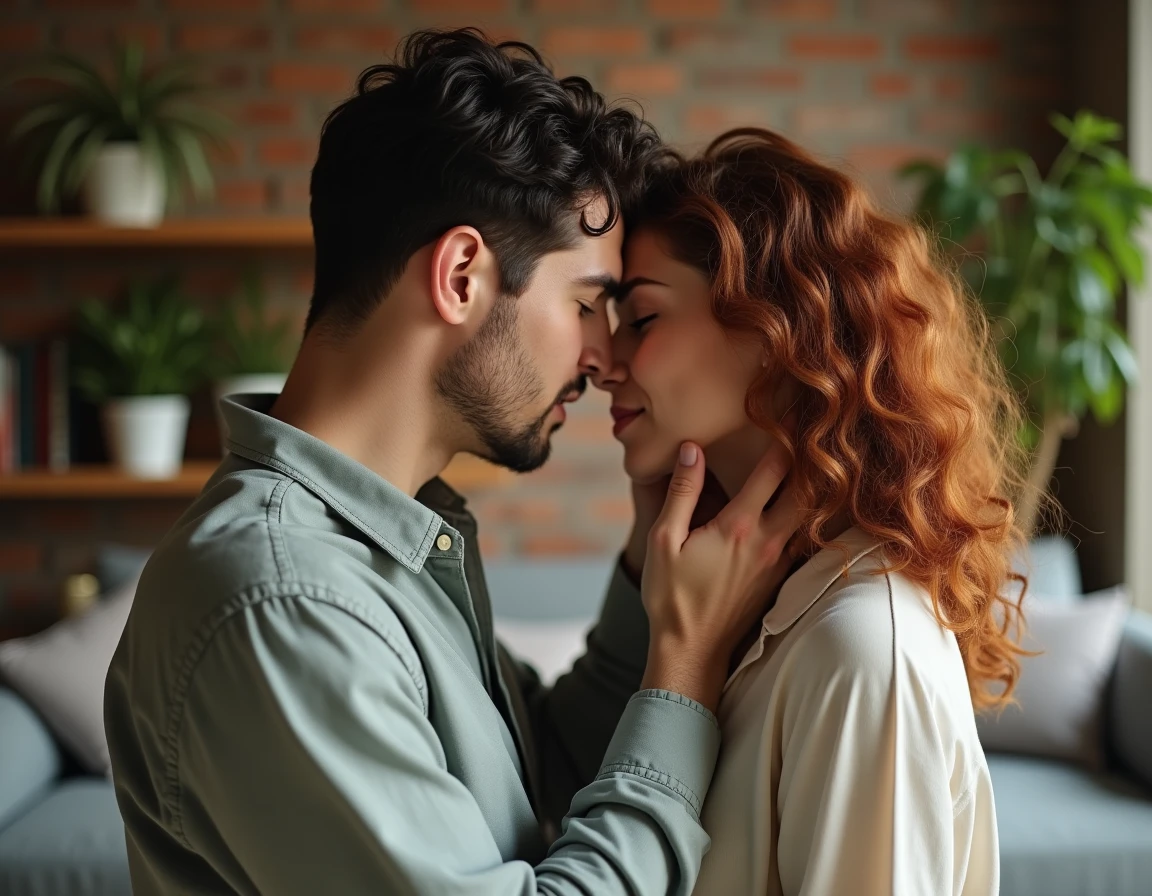
- A man in love often places a hand on the neck or cheek, a gesture that conveys a desire for closeness and protection, not just desire
- Fingers slipping into hair or caressing the jaw indicate a focus on the face as an emotional center, not just the body
- Conversely, hands that remain still or immediately drop towards the lower body generally signal a more physical than emotional motivation
Context and frequency: when the kiss goes beyond the expected frame
The most reliable sign is not found in the kiss itself, but in the moment it occurs. A passionate kiss on a Saturday night after a candlelit dinner, anyone can give. A tender kiss placed on a Tuesday morning while the coffee brews tells a different story.
Men in love kiss outside of “scheduled moments for kissing.” It’s a kiss on the forehead while passing in the hallway. It’s a quick kiss on the temple in the middle of a conversation with friends. Those kisses have no sexual purpose. They serve as points of contact, silent reminders of the bond.
The generational dimension
Feedback compiled by relationship coaches shows an interesting evolution. Younger men describe romantic kissing more as a moment of shared vulnerability: fear of doing it wrong, desire to be present rather than perform. Older generations more often mention it as proof of commitment.
Feedback varies on this point, but this difference in perception directly influences the tenderness, duration, and frequency of kisses. A twenty-five-year-old man in love does not kiss like a fifty-year-old man in love, and both can be perfectly sincere.

What the kiss reveals about the couple’s long-term health
In established relationships, the kiss acts as a barometer. Its gradual disappearance is often cited as a warning sign even before disputes or a decrease in desire.
A couple that continues to kiss on the lips (not just the automatic peck in the morning) maintains a channel of intimacy that sex alone cannot replace. The romantic kiss is the first gesture to disappear and the last to return when a couple goes through a crisis.
Some concrete markers to observe over time:
- The frequency of kisses initiated without romantic or sexual context remains stable, even after several months of relationship
- The man seeks lip contact in public, even in ordinary situations (waiting in line, shopping, driving)
- The kiss is accompanied by a gaze maintained after the lips part, not an immediate return to the phone or ongoing activity
None of these signs taken in isolation constitutes proof. It is their accumulation and consistency over time that paint a reliable picture. A man who kisses differently when he loves does not do so out of calculation. He does it because his body, his hormones, and his attention converge on the same person, and it is felt even in the pressure of his lips.